
Working in Australia can provide Indian professionals with an international experience, career growth, and even opportunities to consider long-term migration. It is important to note, though, that Australian work visas do have different requirements, costs, age limits and conditions of employment, and therefore it is important to select the right visa for the employment opportunity.
Table of Contents
If you are researching an Australia work visa for Indians, this guide will provide you with details on the available visa options, eligibility requirements, application process, and typical costs to keep in mind when applying for a work visa to Australia from India in 2026, along with any necessary precautions.
If you are a good professional looking for sponsorship by the employer, or you are an experienced worker considering a permanent residency visa, it is important to know the options available to you to help plan your next steps.
What is an Australian visa for Indians?
An Australian work visa is a visa issued to a foreign national who is eligible to do work in Australia under certain conditions. Work activities allowed will be determined by the visa issued.
For Indian nationals, employment visas that may be available include employer-sponsored temporary visa, skilled visa, regional visas and selected work and holiday visas.
There is no one specific Australia work visa that is suitable for everyone. There is a possibility that you may be eligible for some options dependent on your occupation, qualifications, work experience, English skill and age and employment offer.
For instance, an experienced IT professional with a job offer from an employer in Australia could consider an employer-sponsored visa, while a skilled engineer who doesn’t have a job offer from an employer may look at points-tested skilled migration.
Please see the official Australian Department of Home Affairs website for the current requirements for eligibility.
Australian Work Visa Types Available to Indians in 2026
The first step is to know the various Australian work visa types. There are visa options available that allow temporary work or permanent residence.
1. Skills in Demand Visa (Subclass 482)
The Skills in Demand visa (subclass 482) is a temporary visa subclass 190 for skilled workers who are suited to an occupation. An approved Australian employer nominates a position that it needs to fill with a suitably qualified worker.
General skills and requirements include the necessary work experience, English proficiency, and relevant skills. The nominated occupation for the Core Skills stream should be listed on the relevant Core Skills Occupation List. The Specialist Skills and Labour Agreement streams have other requirements.
Depending on the stream and eligibility, the visa can be granted for maximum of four years.
This route is suitable for those with a suitable occupation, for example engineering, information technology, healthcare or a skilled occupation, who also have an employer who meets the appropriate criteria.
Official details: Skills in Demand visa subclass 482.
2. Employer Nomination Scheme Visa (Subclass 186)
The subclass 186 visa is a permanent subclass 189 visa. This could apply to people with Australian qualifications who have experienced an employer to nominate them and who meet the relevant requirements.
There are different requirements for the streams available. In many cases, the Direct Entry stream will have specific work experience requirements, as well as the ability to pass a relevant skills assessment certificate (unless exempt), and English language proficiency and meeting the age requirements.
For subclass 482 visa holders, a possible route to permanent residence is the Temporary Residence Transition stream.
If you are aiming for permanent residency in Australia, this is an option to explore.
3. Skilled Independent Visa (Subclass 189)
The subclass 189 visa is a non-employer skilled visa that is a points-tested permanent skilled Australian visa.
The general requirements for the application are an eligible occupation, a suitable skills assessment, competent English, points, and an invitation to apply. Applicants are required to be under 45 years at the time of call.
An invitation is not guaranteed if they meet the minimum points. The outcome of the Invitations is dependent on a range of factors such as occupation and available places.
Read the official subclass 189 requirements.
4. Skilled Nominated Visa (Subclass 190)
The subclass 190 visa is a permanent skilled visa for those who are nominated by a state or territory in Australia.
Applicants will typically require an eligible occupation, an eligible skills assessment, English skills, points, and an invitation. The requirements for state and territory nominations can vary.
This route could also be of interest to practitioners with expertise that is in line with the needs of a participating state or territory.
Official information: Skilled Nominated visa subclass 190.
5. Skilled Employer Sponsored Regional Visa (Subclass 494)
The subclass 494 visa is a visa that is sponsored by an employer and is available to skilled visa holders who are eligible to work and live in specific regions in Australia.
Typically issued for a five-year period. Typically, applicants must hold the appropriate skills assessment (unless exempt), have the necessary qualifications and experience, and have an eligible regional employer. The typical age range is below 45 (exemptions may apply).
Permanent residence may be available to eligible holders under the pathway for which they are eligible if they meet the requirements.
This visa may suit applicants who are open to working outside major metropolitan areas.
6. Work and Holiday Visa (Subclass 462)
The subclass 462 visa is a combination visa that will consist of an extended holiday, along with a work visa in the subclass 462 category granted under the visa requirements.
In case of first visa, Indian citizens holding a passport must take the necessary balloting process and be selected in that, before applying for the visa.
The typical age of applicants is between 18 and 30 (inclusive) and a combination of education, English, financial and other requirements is fulfilled.
This is not a regular skilled work visa sponsored by an employer and there is no guarantee of getting selected by the ballot.
Please see the official subclass 462 page for details on the current rules and ballots.
Australia Work Visa Requirements for Indian Citizens
There are various Australia work visa requirements for Indian citizens depending on the subclass and stream of the visa. Prior to investing in an application, consider the following.
1. Valid Indian Passport
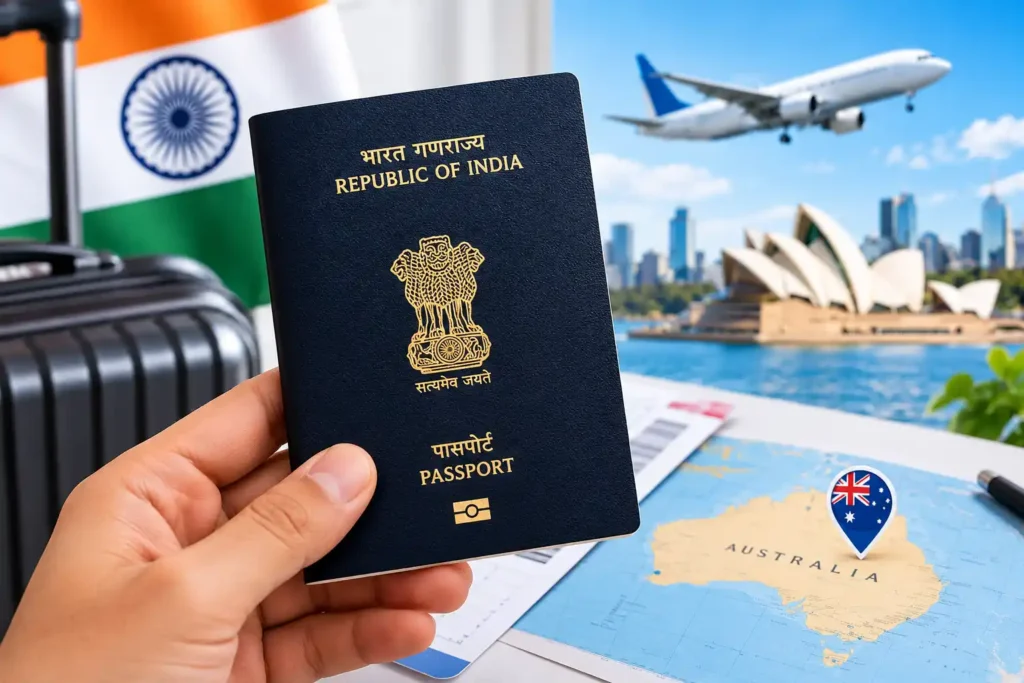
A valid passport is required and identity documents specified in the form are required. Ensure that your personal information is uniform on your passport, qualifications, employment records and applications.
2. Relevant Qualifications and Skills

The educational qualifications must be appropriate to the nominated occupation where required. Skills assessment or professional registration may be required for some occupations.
Some professions require further registration or licensing before working (e.g. some healthcare professions).
3. Relevant Work Experience

The work experience requirements vary according to visa pathway.
Typically, applicants require at least 12 months of experience in the nominated occupation or a related field for the subclass 482 visa. Typical experience requirements are found in other pathways, such as subclass 494 or subclass 186 (Direct Entry).
Generate employment correspondence and job descriptions, pay slips, etc. as appropriate.
4. English Language Proficiency
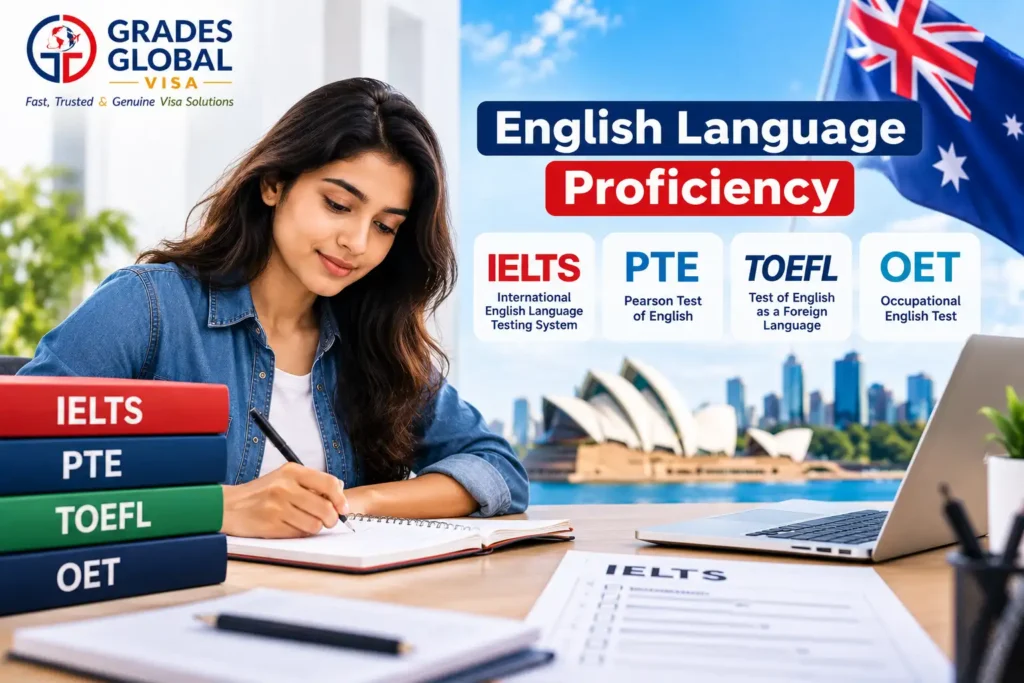
Many Australian work visas require evidence of English proficiency. The minimum scores and exemptions required for the accepted tests depend on the visa.
The English language requirements apply to the subclass 482 visa, based on the relevant visa requirements and the visa exemption. Not all Australian visas have the same IELTS score requirement.
Please check the official requirements before booking a test.
5. Health and Character Requirements
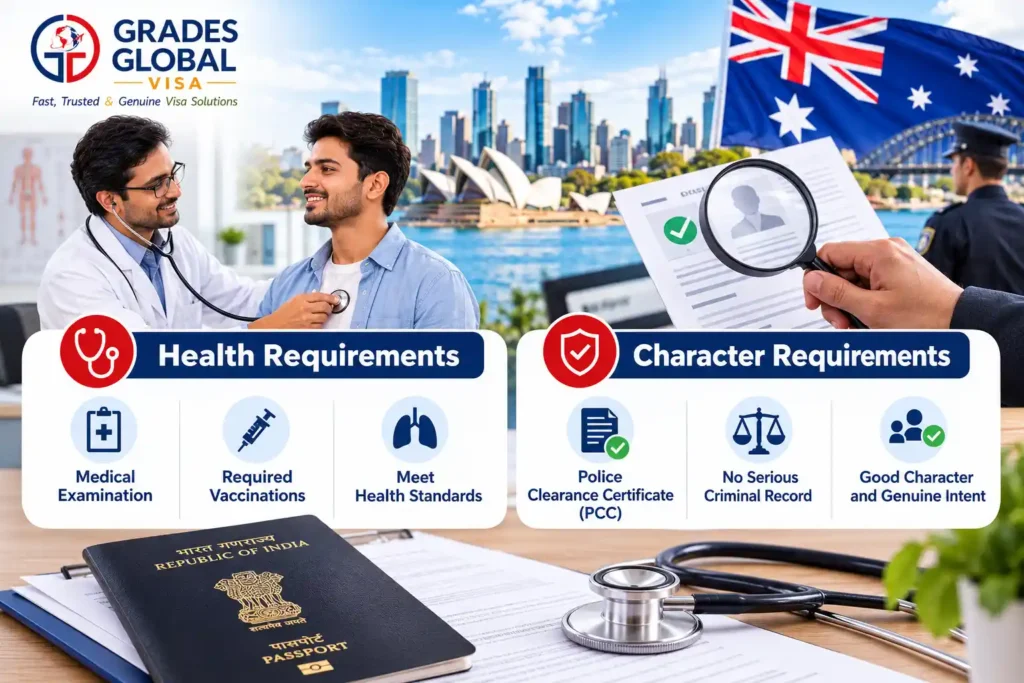
Medical Examinations, police certificates and other evidence may be required to meet Australia’s health and character requirements.
Documents required will vary according to your situation and visa category.
6. Employer Sponsorship or Nomination

An employer-sponsored visa requires you to be nominated by a suitable Australian employer who must comply with the sponsorship criteria.
An offer of work doesn’t mean you will be offered a visa or sponsored. State that the employer, occupation and employment arrangement(s) comply with the requirements.
How to Get Australia Work Visa from India: Step-by-Step Process
If you want to understand how to get Australia work visa from India, follow a structured process rather than applying for a visa before confirming your eligibility.
Step 1: Identify the Right Visa Category
Start by identifying your occupation, qualifications, experience, age and long-term objective.
To begin with, you need to determine your employment, skills, experience, and future goal.
If you have a job offer from a company that is eligible, research employer-sponsored solutions.
Consider assessing the points-tested pathways if you are interested in Permanent Skilled Migration but do not want to work for an employer.
Step 2: Check Your Occupation and Eligibility
Find out if your occupation is eligible and if there is a skills assessment or registration or licensing required.
Review the points criteria and invitation process for points-tested visas.
Step 3: Prepare Your Documents
Collect the documents relevant to your circumstances, which may include:
- Valid passport and identity documents.
- Educational certificates and transcripts.
- Updated CV or résumé.
- Employment references and evidence of work experience.
- English-language test results, where required.
- Skills assessment and professional registration documents, where applicable.
- Police certificates and health examination evidence, when requested.
- Employer nomination details for sponsored visas.
Ensure that your information is accurate and consistent.
Step 4: Secure an Eligible Job Offer if Required
For an employer-sponsored visa, look for a real visa with an employer in Australia who is willing and qualified to sponsor an overseas worker.
Develop relationships through trusted job boards, employer websites and industry sites. Make your CV specific to the job and state clearly what experience you have relevant to the job.
Never pay anyone for a locked-on job or visa.
Step 5: Complete the Employer Nomination Process
Employers will normally be required to carry out the relevant sponsorship and nomination procedures for sponsored visas.
When the appropriate information is available, adhere to the steps required for each visa subclass. Employer sponsorship and the applicant’s visa application are separate parts of the process.
Step 6: Apply Through the Official Online System
Make an ImmiAccount, fill out the appropriate application and submit necessary paperwork.
Submit any further information as requested by the Department of Home Affairs and apply for the visa fee.
In some cases, it may be necessary to submit an Expression of Interest (AoI) to SkillSelect and receive an invitation prior to submitting the visa application for a points-tested pathway.
Step 7: Complete Any Additional Checks
You might need to go to medical exams, give police certificates, give more paperwork or go through more checks.
Complete application within specified time limits and keep track of application status.
Step 8: Wait for the Visa Decision
The processing times are dependent on visa subclass, visa application completeness, individual circumstances and departmental priorities.
Don’t quit your job, book non-refundable tickets or take any assumption that you can start work in Australia until you have the right visa and know what it requires.
Australia Work Visa Cost for Indians in 2026
The Australia work visa cost for Indians will vary with the type of visa applied for and extra assessment and documentation costs.
As an example, the following amounts are published as starting application charges in the Australian Government. Please review the official fee pages as fees are subject to change before applying.
| Visa category | Published starting visa application charge |
| Skills in Demand visa (subclass 482) | AUD 4,015 |
| Work and Holiday visa (subclass 462) | AUD 840 |
| Skilled Independent visa (subclass 189) | AUD 6,135 |
| Employer Nomination Scheme visa (subclass 186) | AUD 6,140 |
| Skilled Employer Sponsored Regional visa (subclass 494) | AUD 6,140 |
These are indicative prices and are not a full quote for all applicants. Additional applicant fees (if applicable) and other costs may add to this total.
What Other Expenses Should You Budget For?
When calculating the work visa for Australia from India cost, consider:
- English-language examinations, if required.
- Skills assessment fees, where applicable.
- Medical examinations and police certificates.
- Document translation or certification, if needed.
- Travel expenses and initial accommodation.
- Professional immigration advice, if you choose to obtain it.
There can be employer-side sponsorship, nomination or levy costs associated with employer-sponsored applications. Do not presume the employee will be personally liable to pay all the employer-side charges; some charges have specific legal rules.
Always check the cost of the visa on the Australian Government’s official visa pricing information.
Australia Work Visa Age: Is There an Age Limit?
The Australia work visa age requirement depends on the particular pathway.
For example, the age requirement for subclass 482 is a general requirement of less than 45 years, whereas the age requirement for other skilled visas is more specific.
In contrast, the age requirement for applicants wishing to apply for the subclass 189 visa, which is a points-tested visa, is usually under 45.
The subclass 186 Direct Entry pathway as well as the subclass 494 pathway also typically includes an under-45 age criterion (with exemptions).
Indian applicants who are 18-30 years of age are eligible to apply for subclass 462 Work and Holiday visa (under the relevant ballot arrangements).
So age should not preclude you from considering your application. If you don’t know the exact subclass and any applicable exemptions, you should check these before choosing your pathway.
Australia Work Visa Duration: How Long Can You Stay?
The Australia work visa duration depends on the visa granted and its conditions.
- Subclass 482: Generally up to four years, depending on the stream and circumstances.
- Subclass 494: Five years, with work and residence restricted to the applicable regional conditions.
- Subclass 462: Generally 12 months for a first visa, subject to its conditions.
- Subclass 186: Permanent residence.
- Subclass 189: Permanent residence.
- Subclass 190: Permanent residence.
Temporary Visas do not become Permanent. Eligibility criteria for the permanent pathway must be met and apply via the pathway.
How Long Does the Australia Work Visa Process from India Take?
The processing time for work visa applications in Australia varies from visa to visa.
The overall process may last for a period of time while finding the job, employer sponsorship, skills assessment, English testing, preparing documents, and the visa decision itself.
Completing an application fully may be treated differently to a partially completed application that needs further checks/information. Occasionally, processing times are adjusted in response to variations in the number of applications received or government priorities.
To estimate your likely waiting period, use the official visa processing time guide.
Keep in mind that the visa processing time is in addition to the time it takes to find a job or to be nominated.
How to Find Australian Jobs Offering Visa Sponsorship
One of the most difficult aspects of the process is finding an employer who will agree to sponsor you.
Utilize existing recruitment platforms, professional networks and career pages on Australian employers’ official websites. Look for jobs that show “sponsorship” or “open to overseas applicants” in the job description.
Before applying:
- Compare your skills and expertise to the role.
- Create a CV in the style of an Australian.
- Emphasize relevant experiences, certifications and quantifiable accomplishments.
- Check the authenticity of the employer and contact information.
- Ensure that the employer is willing and able to sponsor the appropriate visa.
Be aware of advertisements that guarantee jobs in Australia, salaries that are significantly higher than the job’s value, or visa status without providing any supporting evidence and that require up-front payment.
Common Mistakes to Avoid When Applying
By carefully reading the requirements, applicants can minimise unnecessary problems.
Choosing the wrong visa – a visitor visa is not a general work visa. Choose the visa that allows you to work in the job you want.
Ignoring occupation requirements: Positions do not automatically qualify for eligibility. The nature of the occupation, duties, and the assessment requirements that apply are important.
Submitting incomplete documents: Lack of evidence of employment, incorrect dates or personal information can cause an application to be delayed.
Underestimating the cost: Plan enough budget for any visa application charge in addition to any assessments and/or examinations or travel charges.
Trusting guaranteed-approval claims: No consultant or recruitment agent can ever guarantee you a visa. The approval is for the Australian immigration authorities.
Ignoring visa conditions: The conditions of a temporary visa may limit the type of work, occupation, location or employer you are permitted to work for. Check the conditions of the grant.
Frequently Asked Questions About Australia Work Visa for Indians
1. Can Indians apply for an Australia work visa without a job offer?
There are visa pathways that do not sponsor an employer, such as the points-tested subclass 189 visa. Applicants will be required to meet occupation, skills assessment, English, points, and invitation requirements, however. Most of the employer-sponsored visas require an eligible nomination.
2. What is the minimum salary required for an Australian-sponsored work visa?
The salary requirement varies per visa stream and occupation and related income threshold. In addition, there are market salary and workplace requirements to meet when sponsoring employment. Please review the existing subclass 482 visa regulations before making an application.
3. Is IELTS compulsory for an Australian work visa?
English-language evidence is required for many pathways, but the accepted tests, minimum scores and exemptions vary. Review the rules for your selected visa before booking an examination.
4. Can I take my family to Australia on a work visa?
There are visas available in Australia with conditions that allow for the inclusion of eligible family members in the visa application or for them to apply separately. Details of conditions, evidence requirements and extra application fees will differ depending on the visa.
5. Can an Australian work visa lead to permanent residency?
There may be an applicable permanent employer-sponsored pathway for some temporary sponsored workers. Skilled migration is also an option for those who meet the required qualifications, even if they don’t meet the above criteria. Permanence is not automatic and is based on criteria.
6. Can I apply for an Australian work visa from India online?
The majority of Australian visas are submitted online via ImmiAccount. There are some pathways where a visa application may need to be accompanied by certain evidences such as being nominated by an employer, skill assessment or invitation.
7. How much does an Australia work visa cost for Indians?
The cost depends on the visa subclass and additional requirements. The subclass 482 visa has a published starting applicant charge of AUD 4,015, while other pathways have different charges.
Check the current official fee schedule before budgeting.
Final Thoughts: Plan Your Australia Work Visa for Indians Application Carefully
Since an Australia work visa for Indians can offer a pathway to employment in Australia, you must first determine which visa is best suited to your qualifications, occupation, work experience, age, and career aspirations.
Start by identifying an appropriate visa subclass, reviewing the official requirements and preparing reliable supporting documents. If employer sponsorship is required, concentrate on genuine job opportunities and verify the employer before making financial commitments.
For applicants who need help understanding their options, Grades Global Immigration can provide information about the immigration consultation process and help them explore potential pathways based on their individual circumstances.
Ready to explore your options? Contact Grades Global Immigration to discuss your profile and understand the next steps for your Australia work visa journey.
Important: Immigration rules, fees, occupation lists and processing times can change. This article is general information, not legal advice or a guarantee of visa eligibility or approval. Always verify the latest requirements with the Australian Department of Home Affairs before applying.