
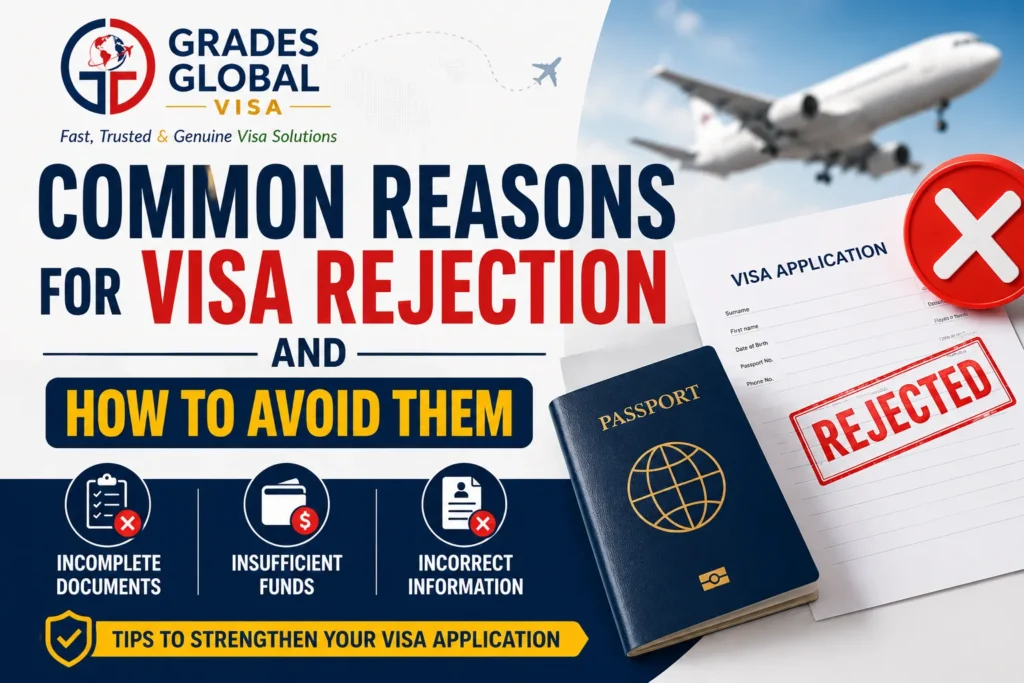
There are several reasons for visa rejection and you should avoid them as well.There are many reasons for visa rejection and you should steer clear of them too.
Table of Contents
Taking the time to apply for a visa is a significant stage in the study, work, travel or settlement process in another country. But despite proper preparation, visa applications can still be denied if they do not meet the requirements of the country to which they are submitted or the visa category.
The rejection of a visa can be disappointing as it can impact travel plans, job prospects, education and immigration objectives. A clear awareness of the common reasons for visa rejection may be beneficial for applicants in order to submit a better and more accurate application.
Whatever the type of visa you are applying for, whether it be a visitor visa, student visa, work permit, skilled worker visa or permanent residency, it is important to be well prepared. Analysis of visa application weaknesses, preparation of documents, and knowledge of eligibility requirements are other areas in which professional visa consultancy services can assist the applicant before submitting a visa application.
What Is Visa Rejection?
When an immigration authority or visa officer decides that a person does not qualify for the visa they are applying for or they do not have enough evidence to make the visa decision, they give the applicant a negative visa decision.
The specific reasons for refusal vary by country and type of visa. For instance, if a visa applicant does not show they are eligible to obtain a visa for the United States, does not submit complete documents, or is legally ineligible to obtain a visa for any reason, then their visa application may be denied.
Analogously, the German authorities claim that incomplete Shoengen applications are likewise rejected, especially if basic application requirements, such as the travel purpose, financial support, insurance, or return arrangements cannot be determined.
1. Incomplete or Incorrect Documentation
The most common visa rejection grounds are incomplete, out-of-date, mismatched, or inaccurate paperwork.
Depending on the type of visa, the applicants may have to submit:
- Valid passport
- Bank statements and financial documents
- Employment or business evidence
- Educational documents
- Invitation or admission letters
- Travel itinerary
- Accommodation details
- Insurance documents
- Police clearance certificates
- Medical documents
- Employment contracts or job offers
Rights to employment contracts or offers of employment
Even if one crucial document is missing, it can lead to a question of whether an applicant qualifies.
How to Avoid It
Compile a document checklist specific to your visa category and specific nation. Ensure that forms are complete, dated, signed, and in the correct format prior to submission.
A professional immigration consultant can also perform a documentation review prior to the application being filed.
2. Insufficient Financial Evidence
Another vital aspect of many visas is financial ability. The applicant may be required to provide proof of their ability to support themselves and any family members that they are accompanied by.
Inadequate or missing bank statements, large deposits, overdrafts, or documents that do not support the applicant’s situation can cause questions to be raised.
How to Avoid It
Keep accurate and honest financial statements. Your financial evidence should tell a consistent story, relating to your income, savings, employment, sponsorship and other financial evidence.
Do not use fake financial documents, or make false statements. It can be far more serious if the visa application is refused due to false or fraudulent information.
3. Providing Incorrect or Misleading Information
Delivering false information on a visa application can have serious consequences for the visa applicant’s case.
Common mistakes involve providing incorrect work experience, failing to disclose previous visa rejections, providing an incorrect travel history, providing incorrect marital information or providing inconsistent information on application forms and supporting documents.
Deliberate misrepresentation or fraud could be a serious immigration problem. Material misrepresentation or fraud is, for instance, a stated basis of eligibility for a U.S. visa.
How to Avoid It
Double check all answers prior to submission. Ensure that the information is accurate, complete and consistent throughout your application, passport, forms, financial documents, employment history and other supporting documents.
When applying for visa, if you have had one previously, tell the officers and provide accurate reasons for your refusal.
4. Weak Travel or Immigration Purpose
The visa officers must be aware of the applicant’s intent to come into the country.
A genuine temporary purpose, if the visa is required, must be demonstrated by the applicant in a case for a visitor visa. In the case of study visa, the proposed course and education should be logical. In the case of the employment visa, the employment must comply with requirements.
Applications can be undermined by an unclear or poorly supported purpose.
How to Avoid It
Create documents that are relevant to an expressed goal. Your application should establish a logical relationship between your training, your planned overseas activity, and the type of visa.
5. Choosing the Wrong Visa Category
The other typically occurring issue is applying for a visa category that is not synonymous with the applicant’s situation.
For instance, a person intending to work overseas should not think that a visitor visa entitles him/her to work. Likewise, applicants wishing to study should opt for the study or student pathway that is suitable for their intended activity but not for one that is not.
How to Avoid It
Before applying, be sure to know the requirements and conditions for every type of visa. When in doubt, it’s best to seek guidance from a professional visa consultant or immigration professional.
6. Inconsistencies in the Application
Errors may arise if data in the application form does not align with data provided in supporting documents.
Examples include:
- Different employment dates
- Different salary figures
- Learner-learner interaction during learning activities
- Conflicting travel history
- Incorrect residential information
Each of the names can be written multiple times with a variety of combinations of letters.
Financial information that does not agree with the declaration of income.
These variations can result in further questions, or refusal.
How to Avoid It
Conduct a complete visa application review. All documents should back up the information contained in the application.
7. Weak Employment or Educational Profile
In some visa categories, professional or educational experience is significant for a visa application.
Skilled migration and work visa programs may require a certain level of occupational, qualification, experience, language, licensing and/or employer sponsorship.
How to Avoid It
Do a thorough visa eligibility assessment before applying. Determine the visa pathways that are relevant to your skills, experience, age, language proficiency, budget and immigration goals.
8. Poor Interview Preparation
A visa interview is a requirement for some types of visa. A candidate could have a good portfolio, but still not fare well if they don’t know how to articulate plans.
Applicants will be expected to answer questions regarding purpose of travel and employment, education, finances, family situation, prior travel, and future plans.
How to Avoid It
Be prepared in an honest manner for possible questions and know the nature of your application well. avoid memorised responses. The answers you give must be accurate and consistent with the information that you submit.
9. Previous Immigration or Visa Problems
Depending on the country, visa refusals, overstays, immigration violations, unauthorized employment or other immigration problems may have an impact on future visa applications.
For instance, the U.S. authorities recognize that past illegal residence is an example of possible grounds of ineligibility.
How to Avoid It
Never cover up past immigration history where disclosure is required. Rather, see why a previous application was rejected or what violations were committed and decide whether the application has been corrected before applying again.
10. Submitting Documents That Do Not Meet Requirements
Unclear, outdated, mistranslated, incomplete, or not submitted in the proper format may lead the documents to be rejected or deemed inadequate.
For instance, official Indian e-Visa instructions state that if the photo or documents submitted with the application are unclear, or fail to meet the requirements, requests can be denied.
How to Avoid It
Read official requirements of the document thoroughly. Provide clear scans, valid documentation, proper translations, and file types.
How to Reduce the Risk of Visa Rejection
While there is no legal way to ensure that a visa will be granted, there is a way to make applications as high quality as possible, following a structured process:
- Please verify your visa status.
- Choose the right type of visa.
- Create a customized checklist of documents.
- Gather authentic financial records.
- Fill out all forms as instructed.
- Review the history of your immigrations.
- Make sure all documents are uniform.
- If necessary, get ready for an interview.
- Make sure to read the entire application before applying.
- Adhere to the current official immigration rules and regulations.
Professional immigration consultancy services might assist you in understanding possible weak points and options if your case is complicated or if you have already had a rejection in the past.
When Should You Consult an Immigration Consultant?
If you have an immigration history that is complicated, you are applying for a work permit or permanent residency, you have been refused a visa before, or you have a large amount of documents to organize, you may want to seek professional assistance if you are not sure you meet the requirements.
Any immigration consultant must be able to give you realistic advice and not guarantee a visa. Candidates are advised to seek clarity and communication, relevant experience, and eligibility based application process.
Why Choose Grades Global Immigration?
Grades Global Immigration has 14 years of experience and provides immigration and visa consultancy services for individuals and families planning to study, work, visit, or settle abroad. The company states that it offers assistance with PR visas, work permits, study visas, visitor visas, and overseas job assistance, with services covering destinations including Canada, Australia, UAE, and Europe.
Grades Global also provides services including profile assessment, documentation assistance, visa application support, and guidance for refusal cases.
If you are searching for visa consultancy services, a work visa consultant, immigration consultant in Delhi, or professional guidance for your overseas immigration plans, you can contact Grades Global for an eligibility assessment and discuss the immigration pathway that may suit your profile.
Contact Grades Global
Phone: +91-8800149591
Email: inquiry@gradesglobal.com
Final Thoughts
Visa rejection can often be avoided by preparing carefully, selecting the correct visa category, submitting complete documentation, demonstrating genuine financial circumstances, and ensuring that every piece of information is accurate and consistent.
Most importantly, applicants should never rely on fake documents, misleading information, or promises of guaranteed visa approval. Immigration requirements vary by country and visa type, so always review the applicable official requirements before submitting an application.
If you are planning to work, study, visit, or immigrate abroad, a professional eligibility assessment can help you understand your options and prepare your application more effectively.